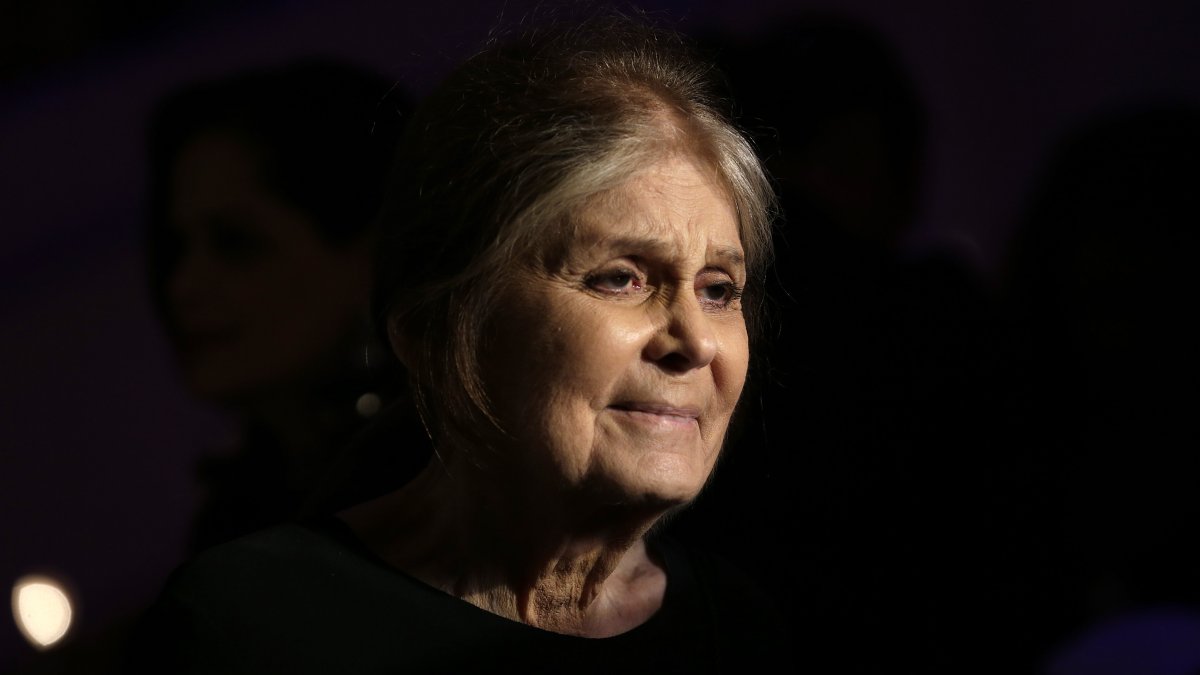
Gloria Steinem, the renowned activist, journalist and leader of the second-wave feminist movement, has died. She was 92.
“Yesterday, Gloria Steinem passed away peacefully at her home in New York City, surrounded by some of the many who loved her. Gloria’s near-century on earth were years well-lived, and she continued working for equality until the very end,” a statement posted to her Instagram account read. It added that she had died on Wednesday.
“Gloria’s greatest gift was her ability to listen to others, to make others feel seen and heard. Her words, actions, and example gave people permission to be their truest selves. Gloria lived true to her independent spirit, always with curiosity and a great sense of humor.”
Steinem, who had been in declining health, had recently completed a memoir, set to be released this fall.
Though Steinem had recently become more frail physically, her wit and humor remained totally intact. Her friend and fellow activist, Abigail Disney, said she’d visited Steinem’s Manhattan home a bit over a week ago, as those close to her gathered by her side. “She was just as funny and just as sharp as I have ever known her,” Disney said. And, she said, generous.
“Everything Gloria did was rooted in kindness,” Disney said. “It flowed through her political activism.”
With her trademark aviator sunglasses and streaked hair parted down the middle, Steinem was a recognizable presence in the women’s rights movement in the United States and abroad, and dedicated her life to various causes, including reproductive freedom, domestic violence prevention, workplace gender inequalities and same-sex marriage.
Born in Ohio in 1934, Steinem launched her career as a freelance journalist in New York City in the 1950s where she fought to write serious stories about politics and women’s rights. Her big break came in 1963 when she reported on degrading conditions in Hugh Hefner’s Playboy empire, an undercover assignment she came to later regret.
In 1969, she spoke for the first time at an event to legalize abortion, sharing her own personal story about secretly terminating a pregnancy in London when she was 22, at a time when the procedure was illegal. She credits that event with changing her career path.
“I just knew that if I went home and married, which I would’ve had to do, it would be to the wrong person; it would be to a life that wasn’t mine, that wasn’t mine at all,” Steinem said of the decision in a 2015 interview with NPR’s “Fresh Air.” Steinem soon emerged as a prominent spokeswoman for the growing movement, speaking at many protests and demonstrations.
Time hardly slowed Steinem down; well into her 80s she was traveling the globe and speaking out on issues of importance to her. These included everything from genital mutilation to Korean reconciliation, but it was equality for women that took precedence. “Being a feminist means that you see the world as whole instead of half,” she once said. “It shouldn’t need a name, and one day it won’t.”
As the years went on, Steinem’s visibility endured. At 83, she sat in the front row of her first fashion show, guest of designer Prabal Gurung. A few days after her 85th birthday, she was leading a women’s “talking circle” at an off-Broadway play celebrating her life, where one by one, women in the audience — many fighting tears — rose to thank her and tell their own stories of discrimination. In 2020, her life was the subject of a feature film, “The Glorias, A Life on The Road,” based on her 2015 memoir and starring Julianne Moore.
And at 91, she collaborated on a picture book with Liberian peace activist and Nobel laureate Leymah Gbowee aimed at inspiring young people to change the world. “Rise, Girl, Rise: Our Sister-Friend Journey. Together for All” was published in February 2026.
The constant visibility came with a price; even into her older years, Steinem expressed frustration that despite her accomplishments, she was often described as beautiful or glamorous. A 1992 Vanity Fair profile even noted her “spectacular racehorse legs.”
“Nobody ever called me beautiful until I was publicly a feminist, and that was in my mid-30s,” she told AP in a 2011 interview. “It was clear that label was being assigned to me. The most hurtful part is that you work very hard, and people say it’s because of your looks.”
Of course, Steinem also had to deal with hostility. Sometimes it came from surprising places. Appearing on Larry King’s talk show on CNN in 1990, she was visibly stunned when a female caller greeted her cheerfully, then told her to “rot in hell” because she had ruined “the beautiful American family.”
But by then, she noted, at least people were taking feminists seriously. That wasn’t the case in 1972 when she co-founded Ms. Magazine and many commentators — especially male — dismissed it as ridiculous, predicting an early demise. (The magazine continues to this day, published by the Feminist Majority Foundation.)
Among Steinem’s detractors was President Richard Nixon, who was caught on an Oval Office tape ridiculing both her and the “Ms.” title. The ridicule was mutual: In a 1972 National Press Club speech, Steinem called Nixon “the most sexually insecure chief of state since Napoleon.”
It was just one example of Steinem’s trademark wit. Before she married at 66, she often explained her singlehood by saying “I can’t mate in captivity.” Laughter, she wrote, was “the only free emotion — the only one that can’t be compelled.”
An unconventional childhood
Gloria Marie Steinem was born on March 25, 1934, in Toledo, Ohio. Her father was a traveling antique salesperson; she spent her early years on the road with her parents, not attending regular school. “I just read everything I could get my hands on,” she told an audience at Manhattan’s 92NY earlier this year.
In 1944 her parents divorced, and 10-year-old Gloria was left to take care of her mother, a once-promising journalist who struggled to combine her work with running a household and who eventually suffered a nervous breakdown.
As a young girl she excelled at tap dancing — it was even going to be her “ticket out of Toledo,” she said. That particular career did not materialize, though, and she attended Smith College in the 1950s — a time when, she said, women were being educated to be mothers and wives.
But marriage was not on Steinem’s mind. “I was engaged to a very nice man. It wasn’t his fault, but I just didn’t want to get married,” she told her 2026 audience. Instead, she took a modest fellowship to travel to India. After that, Steinem headed to Manhattan, where she couldn’t rent her own apartment because landlords assumed if a single woman “could earn enough, you must be a hooker.”
This story uses functionality that may not work in our app. Click here to open the story in your web browser.