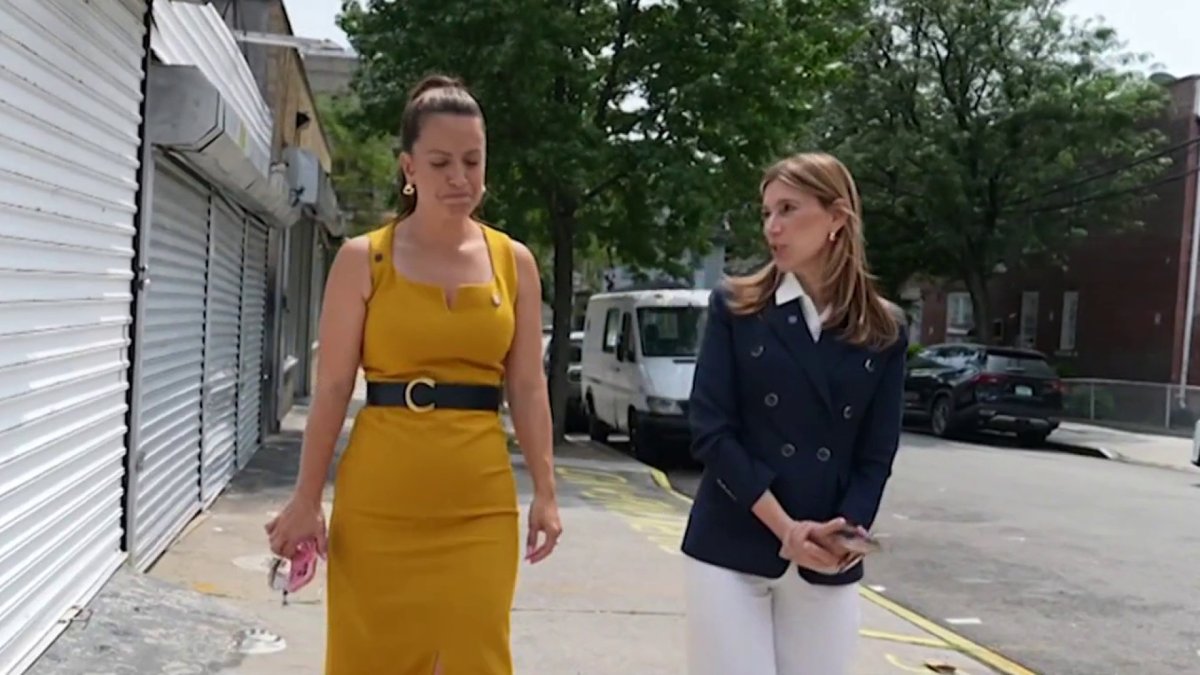
For years she kept it a secret. But about a minute into an interview about cuts that could hurt survivors of sexual assault — she let it out.
“These services save lives,” Queens assembly member Catalina Cruz said, growing emotional.
“I know because it happened to me. I was raped.”
Assembly member Cruz said she had not planned to disclose that she had been raped “in her mid-thirties” when she sat down with NBC New York in her Corona office to discuss funding cuts to Rape Crisis Centers.
The Hochul administration has been shifting millions in federal grant money away from dozens of longstanding, certified, specially-trained crisis centers that support sexual assault survivors 24/7, including children.
“She has to find a solution,” Cruz said, referring to Governor Hochul, whose Office of Victim Services divvies out federal grant money.
Cruz said cutting the free services would leave survivors of sexual assault to experience the “spiraling” and “suicidal” feelings she says she experienced, noting that she was fortunate to have health insurance and to be able to afford therapy.
Cruz has been a powerful advocate for sexual assault survivors, in 2019 disclosing on the Assembly floor that she had been sexually abused by a relative as a child after immigrating from Colombia.
In 2024, Cruz sponsored the bill that broadened the legal definition of rape in New York State, enabling more survivors to come forward.
Still, she says she struggled to speak out about the rape.
“Because it was a friend. It was someone I thought was a friend,” she told News 4.
Cruz did not name the person who she says raped her less than a decade ago.
She said she decided to reveal the rape to encourage others to seek help.
“I want more people to come forward,” she said, adding through tears that she “finally feels free.”
Why are there funding cuts for rape crisis centers in New York?
New York State’s Rape Crisis Centers are calling on Governor Kathy Hochul to restore millions in funding cuts they say will leave sexual assault survivors — including children — without critical services.
“It breaks my heart,” said Karen Hermita of the Kingsbridge Community Center in the Bronx, one of dozens of Rape Crisis Centers alerted by the Hochul administration in July that they will lose federal grant money they relied on in the past. The federal dollars — intended for crime victims — are divvied up by the New York State Office of Victims Services in a competitive process every three years.
Hermita is one of the specially trained, certified Crisis Advocates on call 24/7 to respond to sexual assault survivors in need. She told NBC New York she’s worried the cut will mean delays in helping rape survivors who can be reluctant to call for help.
“They feel ready at that moment, so saying ‘hold on a bit’ when they’re ready to let it all go? That makes me sad,” Hermita said.
Program Director Sadie Mahoney said Kingsbridge is the only fully staffed Rape Crisis Center in the Bronx, so she was shocked to learn in July that the state is eliminating its entire federal grant – its primary funding source for years.
“Losing a funding stream completely is a little shocking,” Mahoney said, during an interview Friday in the program’s garden, where clients work with therapists and a boy swatted butterflies as his mother sought services inside.
“The Bronx has the highest rates of sexual assault across New York City, so this is a huge gap for an area of the City that has the highest rates of violence, Mahoney said, adding that losing the Federal grant leaves her Center down about 25 percent of its budget. NYPD crime stats show rapes spiked more than 50 percent in the 50th Precinct earlier this year.
While two of the three Rape Crisis Centers in Brooklyn also lost all of their federal grant money, other centers around the state lost only a portion, and some received more, according to Emily Miles of the Alliance Against Sexual Assault, which represents the 54 official certified Rape Crisis Centers in New York State. According to 42 centers who responded to a recent Alliance survey, 30 said they’re losing federal grant funding, 29 said they would be forced to reduce staff as a result, and others said they would eliminate free legal services or support groups for survivors, Miles said.
“What we found after surveying our members was that rape crisis programs are going to be seeing a reduction of $5.2 million of investment in their services,” Miles said. “Rape Crisis Centers provide unique, non-duplicated services. If a Rape Crisis Center doesn’t get funding, those services, like meeting survivors at the hospital and helping them navigate the complex systems survivors have to face? That doesn’t happen.”
Programs tell NBC New York that while they were grateful that Gov. Hochul recently doubled the number of dollars they receive from the state’s own Department of Criminal Justice Services, the new federal grant cuts will only offset that increase.
“The Governor has been a champion for survivor services. It doesn’t align with her values to cut programs like this,” said Liz Roberts, CEO of the non profit Safe Horizon, which operates the City’s 5 Child Advocacy Centers – one in each borough – which are facing a $500,000 reduction.
“They are the first line of defense when a child discloses that they have been sexually abused or physically abused,” Roberts said, adding that funding cuts could result in delays and service gaps in this critical safety net.
“I think the risk is that children won’t be interviewed promptly. I think the risk is that children who might have gotten mental health services and follow-up to their disclosure might not get those services because there aren’t enough staff to do it.”
Roberts described the Hochul administration’s funding decisions as “giving with one hand and taking away with the other.”
Gov. Hochul has also received praise for supporting what survivor advocates call a “groundbreaking” new regulation requiring every hospital Emergency Room in the state to provide survivors with trained forensic staff and a Rape Crisis Advocate by 2027. Since many hospitals rely on the Rape Crisis Centers to train and provide those advocates and staff, the cutbacks raise the question of whether hospitals will be able to comply.
A Hochul administration spokesperson said the state’s new annual award of $126.5 million represents “the single largest investment in victim services in the state’s history, allowing us to fund more programs and reach more New Yorkers in need.”
Janine Kava, spokesperson for Hochul’s Office of Victim Services, told NBC New York the state received an unprecedented number of applications, 316, for funding this year and that the dollars requested exceeded the federal dollars available by almost $500 million.
“Never in its history has OVS received that many applicants seeking that level of funding,” Kava said.
“The incredible demand, the state’s competitive procurement process, federal rules and funding uncertainty required us to make difficult decisions.”
Kava said the competitive process is required under state law, but program directors say they want her to change it. They say longstanding programs are being forced into an increasingly competitive process for an unpredictable pot of federal money with results that leave certain geographic areas underserved.
“It’s very upsetting,” said Liz Roberts of Safe Horizon. “It feels like a free for all.”